High-Throughput Single-Photon-Streaming
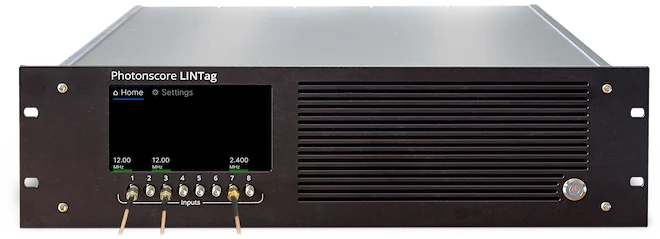
LINTag is the time-tagger system for ultra-fast data acquisition: eight channels, picosecond resolution, and a continuous streaming path from detector to desktop.
Features
Resolution and performance

LINTag maintains uncompromised resolution at any count rate. Timing accuracy stays at 4 ps RMS (9 ps FWHM) on a 1ps digital bin whether a channel sees occasional single photons or runs flat out at 220 MHz, so the instrument response function you calibrate at low flux is the one you get under load. Each of the eight inputs has its own threshold, impedance and polarity setting and is routed independently, keeping channel-to-channel crosstalk minimal even when neighboring channels are driven hard. Fast edges on one input therefore do not shift or broaden the timing on the others, which is what makes dense multi-channel coincidence work practical.
Acquisition software
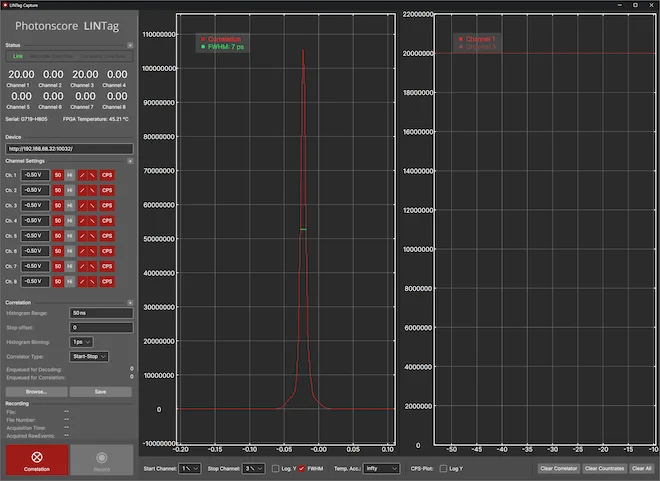
LINTag ships with a graphical user interface for interactive work and a Python API for scripted control both exposing the same functionality, so you can move between them freely. The GUI covers channel setup, threshold and impedance adjustment, live histograms, and coincidence views without writing code.
Everything is scriptable
The Python layer lets you fold acquisition into existing experiment scripts, automate parameter sweeps, and stream tags straight into NumPy for analysis. Nothing is exclusive to one path, so a measurement prototyped in the GUI can be reproduced verbatim in a script.
Remote acquisition by default
The PC link is standard Ethernet, so remote operation is the default mode rather than an add-on. A 10G SFP+ connection carries the full tag stream over copper for short runs or glass fiber for long ones, letting you place the instrument kilometers from the operator. This keeps the time tagger next to the detectors: inside a shielded room, a cryostat bay, or a radiation area, while you run the measurement from a desk elsewhere. Because the interface is a full-stack TCP/IP link, no proprietary cabling or repeaters are required anywhere along the path.
Specification
The time-to-digital converter boasts 8 acquisition channels, each with an adjustable input threshold and impedance. The system can deliver over 350 MTags per second with an accuracy of less than 4 ps, transmitting data to your computer via a 10G Ethernet SFP+ connection that uses a full-stack TCP/IP interface. Because the link is a standard network interface, no acquisition card or proprietary driver is needed on the host, and the same stream can be recorded on Windows, macOS, or Linux. If your application requires lower latency, you can utilize the embedded PC to directly access the time tags from the FPGA, processing or reducing them on the instrument before anything leaves the chassis. That makes LINTag equally suited to long unattended runs, where raw tags are archived for later analysis, and to closed-loop experiments that need a decision within microseconds.
Performance | |
|---|---|
| RMS jitter, ps | 4 |
| FWHM jitter, ps | 9 |
| Digital bin size, ps | 1 |
| Max. input frequency, MHz | 220 |
| Tag transfer rate, MTags/s | 350 |
| Internal computing capability | Intel® 13th Gen. Core™ i7 or equivalent |
Inputs | |
| Signal levels, V | -2.0…+2.5 |
| Impedance, Ohm | 50 |
| Polarity | Positive/Negative |
| Number of channels | 8 |
| External clock input, MHz | 10 positive, negative or bipolar |
General | |
| Power supply | 24V, 12.5A |
| Dimensions, (w × d × h), mm | 480 × 345 × 133 (3U) |
| Connectivity | 10GbE SFP+, HTTP protocol |
| Operating system | Windows (64 Bit), macOS, Linux |
| Embedded OS | Linux |