Quantum ghost imaging recorded with LINCam: 244 million time-tagged photons in 500 s, with the coincidence window chosen after the measurement to form the image. Data by courtesy of Duncan Ryan, Los Alamos National Laboratory.
Ghost imaging forms a picture from photons that never touch the sample. A nonlinear crystal emits photon pairs whose positions are correlated. One photon of each pair passes through the sample onto a detector with no spatial resolution; the other goes straight to a camera. Neither detector alone sees an image. The picture appears only when the two records are brought together pair by pair.
The two photons need not have the same color. Nondegenerate pairs let the sample be probed where it absorbs, here in the near infrared, while the image is formed in the visible, where cameras are sensitive and quiet. The light the sample receives can then be kept far below what a near-infrared camera would require.
LINCam records the position and the arrival time of every photon it detects, together with the time of the last bucket click before it. Nothing has to be gated or triggered while the measurement runs, and no optical delay line is needed to bring the two arms into step: the delay is a number in the file. Pairs are found afterwards, in software, and the coincidence window is chosen once the data are in hand.
Results
The recording holds 243,797,041 photons in 500 s, about 0.49 million per second on the camera against about 0.21 million bucket clicks per second. Summed without regard to the bucket they give only the smooth profile of the down-converted beam (Figure 1, left): the sample stands in the idler arm and leaves no mark on photons that never met it.
The start-stop delay, the camera time stamp minus the time of the preceding bucket click, has a single peak at 5081 ps, 144 ps FWHM in 1 ps bins. The peak bin holds 28,138 photons per ps over a flat floor of 60 accidentals per ps, a ratio near 470. Where the peak sits is set by cable and path lengths and is a constant of the setup. Its width is the whole chain together; nothing measured here separates the SPAD, the camera and the electronics.
A window of ±300 ps about the peak keeps 4,733,128 photons, 1.94 % of the file, of which 0.8 % are accidental. Those photons form the image on the right, in which the transmission mask of the ghost target is resolved. Narrowing to ±100 ps leaves 3,845,868 photons, 1.58 % of the file, at 0.3 % accidental; widening to ±500 ps raises the accidental fraction to 1.25 % and adds little else. Because every photon carries its own time stamp, the window is applied after the fact and can be changed on the recorded file without repeating the measurement.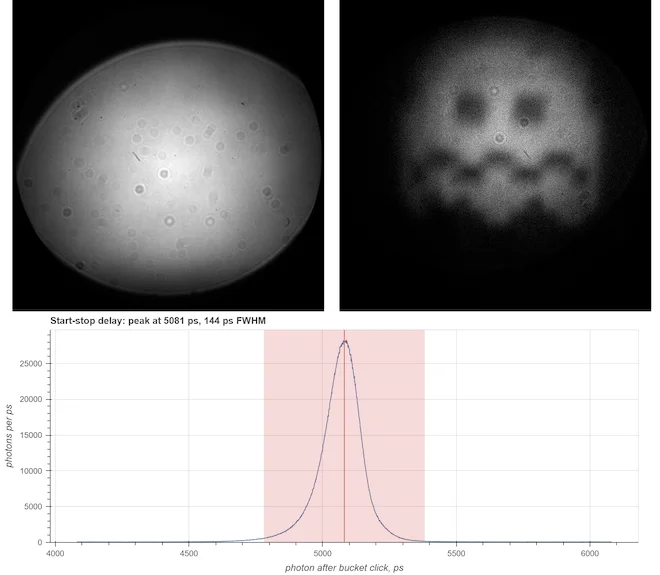
Setup
The measurements were performed on the nondegenerate QGI setup described in Ryan et al., Optica 11, 1261 (2024). A 405 nm continuous-wave laser pumps a 1 mm periodically poled KTP crystal, generating spatially correlated photon pairs by spontaneous parametric down-conversion: a 562 nm signal photon and a 1450 nm idler photon. Only the idler meets the sample. The pairs are collimated by a parabolic mirror and split at a dichroic beamsplitter. In the idler arm the crystal face is relay imaged onto the sample and re-imaged onto a free-running InGaAs/InP single-photon avalanche diode, which acts as the bucket detector. In the signal arm the crystal face is relay imaged onto LINCam, which records the position and arrival time of every detected photon. The SPAD pulses are fed directly into the synchronization input of LINCam, so coincidences are recovered in software and no optical delay line is required. The ghost image is then formed from those signal photons whose arrival times fall inside the coincidence window. The camera was a LINCam V3 and the file discussed here was recorded on 2024-09-17.
Acknowledgement
The data were recorded by Duncan Ryan at Los Alamos National Laboratory, on the setup of Ryan et al., Optica 11, 1261 (2024), and are published here with his permission. Photonscore did not build the setup and did not take the data; what is shown here is the camera and the analysis of the recorded file.
Data and code
The code of ghost.py and ghost.ipynb, together with a README, are available at GitHub.
Photonscore Preview, which is part of the LINCam software on our downloads page. ghost-dataset.photons 2.9 GB The full recording of every photon of the 500s measurement, with position in 12bit on each axis and both time stamps, its own and that of the preceding bucket click, in picoseconds. The file also carries the delay in 100 ps channels, which is too coarse for a 144 ps peak and is not used here. ghost-only.photons 51.9 MB Holds the ±100 ps selection alone. It is small enough to open instantly with Preview.